Showing posts with label uk navy. Show all posts

Wednesday, February 16, 2011

HMS Clyde honours the men of '82


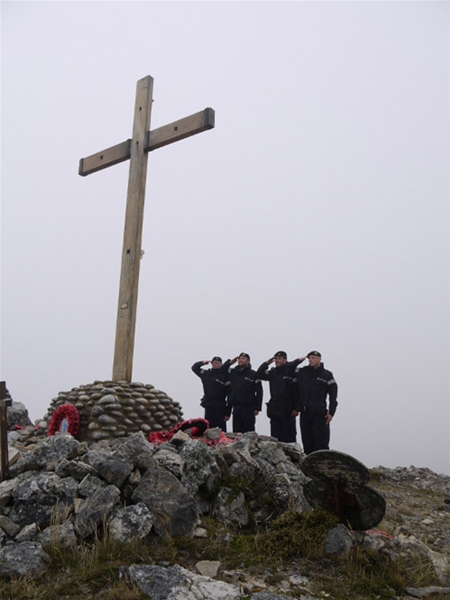
SALUTING their fallen forebears, four sailors from HMS Clyde honour the crew of HMS Coventry after restoring their memorial.
The ship’s company of today’s Falklands guardian have spent the past few weeks tidying up monuments and memorials peppered around the archipelago as their vessel patrolled the islands.
Either Clyde or the RN’s South Atlantic Patrol Ship regularly maintain some of the outlying memorials – most recently HMS Portland’s sailors smartened up the Coventry on Pebble Island monument last summer.
Just a few months later, however, the ferocity of the South Atlantic weather meant a return to Pebble Island was in order, so the men of Clyde duly obliged.
The sailors have also tackled three other memorials during their recent patrols of the Falklands: 2 Para’s monument at Goose Green, 42 Commando’s on Mount Harriet, half a dozen miles outside Stanley – and the scene of bitter fighting in the final days of the 1982 conflict – and the HMS Sheffield cenotaph.

The latter stands on Sealion Island, overlooking the point several miles away where the Type 42 destroyer was fatally hit by an Argentine Exocet missile.
Elsewhere a bit of Brasso and some good old elbow grease sufficed to spruce up memorials, but on the exposed Bull Hill where the Sheffield cross and cairn are located, the elements had taken their toll.
The Clydes found the stone wall surrounding the monument had been damaged by storms the previous work. It was returned to its normal state before a formal salute to Shiny Sheff’s 20 dead.
Related tags .....

Tuesday, February 15, 2011

Royal Navy’s ‘HMS Queen Elizabeth’ under construction


Pictured here is construction of the first of the two new aircraft carriers for the Royal Navy, HMS Queen Elizabeth, as workers at BAE Systems’ Govan yard moved two giant sections of the hull together for the first time.


The structure is so big that it fills an entire hall at Govan and now extends beyond the doors onto the yard.


It took a team of 20 employees and remote controlled transporters just one hour to move 1,221 tonnes of steel over 100 metres across the shipyard. The hull section was then manoeuvred carefully into position to line up with the rest of the block.
The two sections brought together today form the mid section of the hull up to the hangar deck and is referred to as Lower Block 03. Workers will continue to outfit the block, which on completion will weigh over 9,300 tonnes and stand over 23 metres tall, 63 metres long and 40 metres wide. She is set to embark to Rosyth in the latter part of this year, where HMS Queen Elizabeth will be assembled in the dry dock.

Related tags .....

Last sight of the Busy Bee at sea as HMS Manchester pays off


THERE’S the very last chance to see HMS Manchester sailing under her own steam under the White Ensign on Thursday.
The venerable destroyer makes her final entry to Portsmouth before decommissioning after 29 years’ service.
The last duty for the Type 42 – currently to be seen on Channel 5 on Mondays in Royal Navy: Caribbean Patrol – is to thank loved ones for their support down the years.
That comes courtesy of a ‘families day’ – basically showing relatives (young and old) of the 260 ship’s company what the ship can do, laying on a bit of a show for them.
The ‘Mighty Manch’/’Busy Bee’ has already said her goodbyes to her namesake city with a service of thanksgiving followed by a (very wet) march through the streets of Manchester (and chance to dry out at a reception in the city hall).

In all the ship has clocked up 858,882 nautical miles since her launch in Barrow back in 1980 and served with distinction through the first Gulf War, providing an umbrella against Iraqi air attacks for the naval task force.
“Although Manchester is decommissioning, it is her people that bring the ship to life and as the ship’s company move on to other units, the spirit of the ‘Mighty Manch’ will live on,” said the destroyer’s final Commanding Officer, Cdr Rex Cox.
“The ship has served the Royal Navy for 30 years and has a fine pedigree that includes seeing active service in the Gulf during Operation Granby; more recently she has been an integral part of counter narcotics operations and hurricane relief in the Caribbean.”
The ship will be formally decommissioned in a ceremony at Portsmouth Naval Base on February 24. Her paying off is long-planned in line with the arrival of the successor Type 45 destroyers, three of which are now in Royal Navy hands.
Weather permitting, HMS Manchester should be passing Round Tower at 3.35pm on Thursday February 17.
HMS Manchester returns from her final deployment – to the Caribbean – just before Christmas 2010. Picture: LA(Phot) Aaron Hoare
Related tags .....

ABS announces new CEO


ABS Announces Christopher J. Wiernicki to Become CEO, Robert D. Somerville Remains as Chairman
(Houston, TX—)  ABS President and Chief Operating Officer Christopher J. Wiernicki will assume the duties of Chief Executive Officer of ABS following the classification society’s annual meeting in April 2011. Robert D. Somerville, currently Chairman and CEO of ABS, will relinquish the CEO responsibilities while remaining Chairman of both ABS and the ABS Group of Companies. Wiernicki, a member of the Board of Directors of ABS, has been working closely with Somerville for the last four years in his position as President and COO. The role of CEO will be in addition to Wiernicki’s existing responsibilities.
Highlighting the fact that ABS is poised to celebrate the 150th anniversary of its formation in 2012, Somerville stressed, “It is important for our clients and employees that we maintain a consistent management and operational philosophy – one that is firmly committed to ABS’ mission. It is a reflection of both our management strength and our commitment to continued expansion that I can relinquish the CEO responsibilities in April. This will allow me to better focus on charting the strategy that will help secure the future of ABS for the coming decades.”
Commenting on the transition, Wiernicki noted that “The scope of classification services has expanded significantly over the last few years and it is clear that it will continue to change at an even more rapid pace. ABS is determined to be the leader in defining the role of class in this new environment. My primary focus will be to ensure that ABS is at the forefront when it comes to providing the innovative products and efficient services that will define ABS as the class society of the future.”
The new management structure mirrors that of the ABS Group of Companies, a leader in the provision of independent risk management services to energy, government, insurance and industrial sectors. Tony Nassif serves as CEO and President of the ABS Group of Companies.
Wiernicki, a 17 year veteran of ABS has held a number of other senior positions within the organization including President and COO of ABS Europe Ltd, Chief Technology Officer and President and COO of ABS Group. He joined ABS in 1993 as Vice President of Engineering within the ABS Americas Division. Prior to ABS, Wiernicki was President and Chief Executive of Designers and Planners Inc., one of the leading naval architecture firms in the United States
Wiernicki holds a BS degree in Civil Engineering from Vanderbilt University and Masters’ degrees in Structural Engineering from George Washington University and Ocean Engineering from Massachusetts Institute of Technology. Additionally, Wiernicki is a graduate of the Harvard Business School Advanced Management Program.
Pictured: ABS’ soon-to-be CEO,  Christopher J. Wiernicki courtesy ABS
Related tags .....

HMS Queen Elizabeth Steps Out Into the Lime Light


Construction of the first of the two new aircraft carriers for the Royal Navy, HMS Queen Elizabeth, took a huge step forward today as workers at BAE System' Govan yard moved two giant sections of the hull together for the first time.
The structure is so big that it fills an entire hall at Govan and now extends beyond the doors onto the yard, providing a spectacular view from across the River Clyde.
Highlighting the skill and technology involved in British shipbuilding today, it took a team of 20 employees and remote controlled transporters just one hour to move 1,221 tonnes of steel over 100 metres across the shipyard. The hull section was then manoeuvred carefully into position to line up with the rest of the block.

Steven Carroll, Queen Elizabeth Class Project Director at BAE Systems’ Surface Ships division, said: “Seeing the mid section of the carrier come together brings into sharp focus the sheer scale and complexity of this engineering feat.
“With construction underway at six shipyards across the country, it is one of the biggest engineering projects in the UK today – second only to the London 2012 Olympics – and we’re all very proud to be a part of it.”
The two sections brought together today form the mid section of the hull up to the hangar deck and is referred to as Lower Block 03. Workers will now continue to outfit the block, which on completion will weigh over 9,300 tonnes and stand over 23 metres tall, 63 metres long and 40 metres wide. She is set to embark on the next stage of her journey to Rosyth in the latter part of this year, where HMS Queen Elizabeth will be assembled in the dry dock.
As a member of the Aircraft Carrier Alliance, BAE Systems is working in partnership with Babcock, Thales and the Ministry of Defence to deliver the nation’s flagships. This huge massive engineering project is rapidly gaining momentum and employs over 8,000 people across shipyards in Glasgow, Portsmouth, Appledore, Rosyth, Merseyside and Newcastle, with thousands more across the supply chain.


Related tags .....

Monday, February 14, 2011

BOEMRE – Oil Spill Containment Systems Not Ready Yet


HOUSTON (Dow Jones)–Oil companies haven’t been able to show that they can effectively respond to a future oil spill in the deep-water Gulf of Mexico–and until they do so, U.S. regulators will not let them drill there, the head of the Bureau of Ocean Energy Management, Regulation and Enforcement said Friday.
Even though the oil industry “has been working hard” and made substantial progress toward developing an oil spill containment system, “it has not been able to fully demonstrate it has the systems in place to respond to a blowout in deep-water,” Michael R. Bromwich said at an offshore energy conference in Houston. “It would be simply irresponsible” to allow deep-water drilling without knowing a blowout similar to the one that led to a massive oil spill last year can be controlled, he said.
Bromwich’s agency has been criticized for holding back on permits despite the official end of a deepwater drilling moratorium, effectively paralyzing the offshore oil industry. But the official said that the industry knows that “containment capabilities aren’t there yet,” although “they will be there soon,” paving the way for permits approval..

Related tags .....

Huge sections of the future carrier are joined


IF YOU want an idea of the scale of Britain’s future carriers, this photograph should provide a few clues.
This is one gigantic section of HMS Queen Elizabeth being manoeuvred into the ship hall at BAE Systems’ Govan yard on the Clyde...
...where it was attached to another section to form Lower Block 03 – the mid-section – of the 65,000-tonne leviathan.
It took just an hour to move this segment from one part of the yard to the shed using a series of remote-controlled transporters and a team of 20 workers.
When complete the now joined block will weigh more than 9,300 tonnes. It stands 23 metres tall (75ft) and is 40 metres wide (131ft). And big though this section is, it only goes up to the hangar deck.

“Seeing the mid-section of the carrier come together brings into sharp focus the sheer scale and complexity of this engineering feat,” said Steven Carroll, in charge of the carrier project at BAE Systems.
“It’s one of the biggest engineering projects in the UK today – second only to the 2012 Olympics – and we’re all very proud to be a part of it.”
Six yards across the UK and 8,000 shipwrights, technicians and engineers are building sections of the two carriers, with thousands more people employed in the enormous supply chain providing kit for the ships.
Fitting out of Lower Block 03 is now being carried out before the block is floated around to Rosyth where the Queen Elizabeth is being assembled later this year.
Related tags .....

Frigates work together for the final time


In the foreground HMS Cumberland. Beyond her, her sister HMS Cornwall.
Never again will two Type 22 frigates work together on operations – in this case safeguarding the troubled waters east of Suez.
Both are conducting their final deployments: the Fighting Sausage initially in the Gulf, now outside it; Cornwall as the flagship of Combined Task Force 151 keeping pirates under the thumb off the Horn of Africa.
All four 22s were axed under last year’s defence review: HMS Chatham has already paid off, Campbeltown is due to decommission imminently.

Their two remaining sisters are now working in tandem in the Gulf of Oman against the ever-present threat of piracy in the busy shipping lanes between Somalia and the coasts of Iran and Pakistan. 
There was still time for a brief break from maritime security operations for this last, historic photo opportunity to produce some iconic imagery for the respective ship’s companies.
“Both of these ships have served our country well over more than 20 years in service,” said Capt Steve Dainton who is, understandably, “extremely proud” to be Cumberland’s last Commanding Officer.
“The name ‘Cumberland’ has been in use almost continuously for RN warships since 1695, with this ship being the sixteenth to bear the name: she has a proud lineage.  So I hope that, in time, there will be another HMS Cumberland.
“In the meantime, we continue to focus on the task in hand before we return to the UK in the spring.  As you’ll have seen in the news, the pirates are very active and an increasing threat: never has our job out here been more important to UK energy and trade interests in the region.”
A series of events will be held onboard in Devonport on the frigate’s return to mark Cumberland’s passing including a reception and dinner for former COs, a reception for ship’s company past and present,  and finally the decommissioning ceremony on May 26.
Related tags .....

Friday, February 11, 2011

Cornwall and Richmond meet up to tackle piracy


FRESH from a rendezvous with an old friend – the former HMS Active – another encounter with a well-known comrade for HMS Cornwall.
This time the Indian Ocean meet-up was with HMS Richmond, new to the area as she begins European Union humanitarian duties.
As the Type 23 has just arrived in Pirate Alley, while the Fighting 99 is an old hand, Richmond called upon Cornwall’s expertise.
Her command team received a thorough briefing on the latest information regarding brigandage in the region from the Type 22’s CO, Cdr David Wilkinson; his ship is currently the command vessel for Combined Task Force 151, one of several naval groups trying to deal with the problems of piracy, terrorism and smuggling in waters east of Suez.
As for Richmond, she’s attached to the European Union Naval Force (EUNAVFOR) under the direction of Spain’s Rear Admiral Juan Rodríguez.

As part of her wider anti-piracy mission, the newly-arrived frigate will shepherd aid ships into Somalia.
Richmond has been charged with escorting ships through the pirate gauntlet to ports in Somalia as part of the UN World Food Programme; half the Somali population depends upon these deliveries for their survival.
“It is this challenge that provides the greatest reward for many of the sailors in HMS Richmond, knowing that they have a key part to play in some of the most important events of today,” said the frigate’s Commanding Officer Capt Mike Walliker.
Before the rendezvous with Chatham, Richmond had paid a short visit to Djibouti – a first for many of the Type 23’s ship’s company.
As well as the usual tasks – maintenance, calls on local leaders and discussions about Richmond’s impending mission in the Indian Ocean – there were runs out for the warship’s rugby and football teams.
HMS Richmond breaks away from HMS Cornwall – as seen from the latter’s forecastle. Picture: LA(Phot) Dave Jenkins, FRPU East
Related tags .....

Thursday, February 10, 2011

Diamond jubliation in Aberdeen this weekend


THERE’S some sparkle in the Granite City this weekend as her own warship sails in.
Brand-new £1bn destroyer HMS Diamond sails into Aberdeen for her inaugural visit, taking a break from extensive trials.
Although some of the ship’s company have already forged ties with the Scottish city – and have paid a few visits – the Type 45 destroyer has not.
Trials off the Scottish coast (including some work with the Sea Kings of HMS Gannet) have finally afforded the chance for Diamond herself to drop in on Aberdeen...
...which she’ll be doing tomorrow morning at the city’s Clipper Quay.
The ship will remain there over the weekend, opening up her upper deck to visitors between 1pm and 4.30pm on Saturday, allowing the public to see a little of the hi-tech wizardry which makes her Britain’s most advanced warship – and to chat to the ship’s company without whom that wizardry would count for nought.
As well as the general public, the ship is hosting three local Sea Cadet units, TS Scylla, Gowanlea and Bon Accord, and putting on a capability demonstration (minus firing her main armament obviously...) for Aberdeen’s movers and shakers.

In turn Aberdonians, led by the city’s Lord Provost Peter Stephen, are holding a celebratory dinner at the Beach Ballroom for the ship’s company.
Diamond will be alongside in the harbour until 9am on Monday when she resumes her extensive trials.
A stern shot of HMS Diamond on trials last week off Plymouth - as seen from HMS Monmouth. Picture: LA(Phot) Stu Hill
Related tags .....

Offshore Drillers Rise In Wake Of Ensco Buyout Of Pride


Shares of offshore drillers Atwood Oceanics Inc. (ATW) and Rowan Cos Inc. (RDC), among others, jumped as Ensco PLC’s (ESV) $7.3 billion deal for Pride International Inc. (PDE) lifted the sector’s valuation and sparked debate as to who’s next.
U.K.-based Ensco said Pride shareholders will receive a combination of stock and cash amounting to $41.60 per Pride share, or a 21% premium to Friday’s closing price. The deal will create the second-largest offshore driller in the world after Transocean Ltd. (RIG, RIGN.VX).
Pride’s shares surged 16% to $39.80 and helped lift shares of Atwood and Rowan.

Jefferies said in a note that although there are several smaller offshore drillers in the market, the two larger companies investors are likely to focus on as takeout targets are Atwood, due to its attractive newbuild pipeline, and Rowan, due to its high-spec jack-up fleet.
Atwood Chief Financial Officer Mark Mey said that while at the right price, everybody is for sale, there’s nothing that Atwood is currently doing to accelerate that focus on the company.
“What we’re doing is trying to create long-term shareholder value,” Mey said.
A representative for Rowan couldn’t immediately be reached for comment.
Atwood closed 5.5% higher at $43.06, while Rowan rose 3.3% to $37.77. Both stocks hit 52-week highs Monday.
Morgan Stanley, which upgraded Atwood to overweight from underweight, said the Ensco-Pride deal implied a valuation of more than $800 million per newbuild floater, suggesting a net asset value of $52 a share for Atwood.
In addition, the firm said, Atwood’s recent management changes and its current fleet renewal program should allow the company to trade at a premium to its larger U.S. peers–despite having historically traded at a discount. As a result, Morgan Stanley raised its price target on the stock to $55 from $36.
The firm also has an overweight rating on Rowan.
Other drillers seeing a lift included Hercules Offshore Inc. (HERO), up 2.9% at $3.59.
“A deal like this is good for the entire group, just the fact that there’s interest in rigs,” said Global Hunter Securities analyst Matt Beeby. “It shines the light on this group again as far as being attractive, and rigs are still going to be needed.”
The offshore drilling industry has been under pressure since the Deepwater Horizon disaster in the Gulf of Mexico. A drilling moratorium imposed after the explosion was officially lifted late last year, but U.S. authorities have been slow to award new deep-water drilling permits. Analysts say the uncertainty surrounding the sector has made it ripe for consolidation.
“Being bigger is better in the offshore business,” said Duncan Williams analyst Lewis Kreps. He added that after the accident last spring, companies are going to have to be big to meet all the qualifications, have a strong balance sheet and need to be diversified both in terms of geography and customer base.
Pride had been exploring a sale since last year and held talks with a number of possible suitors including Seadrill Ltd. (SDRL, SDRL.OS), a large Norwegian drilling contractor that already owns roughly 9% of Pride after an aborted attempt to buy the whole company in 2008.
Global Hunter’s Beeby said that while Seadrill may retain shares of Ensco, the deal could also serve as a catalyst for Seadrill to put cash to use. He noted that investors are likely bidding up shares of Rowan on the possibility of a Seadrill/Rowan-type of deal, which could make an attractive venture.
He said that Rowan is largely considered a quality jack-up player, but doesn’t have a floating rig business, whereas Seadrill has both. However, Beeby said he doesn’t know that Rowan would be willing to sell itself.
Related tags .....
CEO Clarifies His Motives – ENSCO Purchased Pride For Its ‘Employees & Customers, Not Rigs’


HOUSTON-(Dow Jones)- London drilling company Ensco PLC (ESV) is buying rival Pride International Inc. (PDE) rather than ordering its own new drilling rigs in order to gain access to the Texas company’s employees and customer base, Ensco Chief Executive Dan Rabun said.
“It’s easy to order rigs; it’s little tougher to contract them and operate them,” Rabun said Monday during a conference call discuss Ensco’s planned $7.3 billion acquisition of Pride. “This is clearly about access to assets, access to people and access to markets and customers, which just ordering and new-building does not necessarily give you.”
In the deal announced Monday, Pride International shareholders will receive a combination of new Ensco shares and cash that amounts to $41.60 for each Pride share they own–a 21% premium over the stock’s Friday closing price.

Pride International shares surged 15.88% to $39.85 in Monday trading. Meanwhile, Ensco’s stock fell 4.45% to $51.99.
The companies expect the merger to close early in the second quarter.
The resulting company will become the world’s second-largest offshore-drilling contractor with a fleet of 74 rigs, second to Transocean Ltd. (RIG, RIGN.VX) and its 138 rigs. The new enterprise will have an enterprise value of $16 billion and a contract backlog of about $10 billion.
The merger also will create what will be the second-youngest and largest deep- water fleet in the world, said Pride Chief Executive Louis Raspino. The new company will boast 21 deep-water rigs with an average age of seven years.
Pride has been aggressive in adding new ultra-deep-water drill ships in the last five years, having ordered five, with an option to build a sixth. Those drill ships command day rates that often exceed $500,000 and are capable of drilling in up to 12,000 feet of water–more than twice the depth at which Transocean’s Deepwater Horizon was drilling when it exploded in the Gulf of Mexico and unleashed the largest marine oil spill in U.S. history.
Rabun said Ensco has “no intention” of selling assets to reduce debt related to the acquisition and that the new company will continue to look to update its fleet. “We will clearly have the capacity to reinvest in the business,” he said.
The executives said the most compelling reason to combine their companies was that they seldom compete for business in offshore basins, with each company having strong positions where the other is weak or absent.
“The strategic fit in terms of geographic reach is remarkable with minimal overlap,” Rabun said.
Pride will bring to Ensco its “extensive operating experience” in Brazil and West Africa, two of the fastest growing deep-water markets. Meanwhile, Ensco will now be able to market Pride’s ultra-deep-water drill ships in markets where Ensco holds a significant position, including Europe, Mexico and the Pacific, Rabun said.
Related tags .....

Wednesday, February 9, 2011

Oscar winning Sir Ben seeks inspiration at HMS Raleigh


ONE of Britain’s greatest actors spent a day at HMS Raleigh as he sought inspiration for a film.
Oscar-winner Sir Ben Kingsley is looking into a Great War project – and was keen to see one of the Torpoint establishment’s most prized possessions to assist his research.
A century ago boy seaman John Travers Cornwell became one of the country’s most celebrated naval heroes and earned a posthumous Victoria Cross for his actions at Jutland in 1916.
The 16-year-old continued to serve at his post aboard HMS Chester despite his gun receiving four direct hits; when the cruiser withdrew from the battle, Cornwell finally received treatment but succumbed to his wounds in hospital in Grimsby two days after the battle.

Although he was originally laid to rest in a common grave in a London cemetery, news of his bravery spread, and a popular clamour for recognition led to Cornwell being re-buried with full military honours, the VC being awarded and court painter Frank Salisbury honouring the boy’s deeds on canvas.
Ninety-five years later that recently-restored painting enjoys pride of place in St Paul’s Church at Raleigh.
The training establishment’s Commanding Officer Capt Steve Murdoch explained how today’s young sailors learn about Cornwell’s dedication and bravery – and hopefully can draw some inspiration from his deeds.
“Jack was just 16 years old when he took part in the battle – and only four weeks out of training.
“As he’s close in age and experience to many of today’s recruits, he’s someone they can identify with – and he’s a fine example of someone who displayed all of the Royal Navy’s values of courage, commitment, discipline, respect and integrity.”
Having spent time in the ‘presence’ of Boy Cornwell, Sir Ben, who won an Oscar for his portrayal of Gandhi nearly 30 years ago and has appeared in a string of critically-acclaimed movies including Schindler’s List and the House of Sand and Fog, toured Raleigh’s new heritage centre and witnessed a passing out parade of rookie sailors who’d completed their nine-week basic training.
“The parade and the emotional scenes of pride and achievement will stay with me for a long time,” said Sir Ben.
“The pride and dignity of the recruits – and their friends and relatives – was an indelible image. All this heightened by awareness of Jack Cornwell’s extraordinary courage and sense of duty.”

Capt Steve Murdoch shows Sir Ben Kingsley around Raleigh's new heritage centre. Picture: Dave Sherfield, HMS Raleigh

Related tags .....

No more Up and at 'Em - HMS Chatham bows out


FOR the last time in a proud career spanning more than 20 years, the White Ensign is hauled down on HMS Chatham.
The Type 22 frigate formally bowed out of service yesterday at a decommissioning ceremony in Devonport – the first of five warships axed under last autumn’s defence cuts to officially pay off.
In suitably bleak weather (cold, rain) to mark the solemn occasion, more than 100 guests – friends, families, VIPS, affiliates and dignitaries from Kent – joined the ship’s company in bidding farewell.
Among those saying their goodbyes was Admiral Sir Ian Forbes, Chatham’s first CO back in 1990 when the frigate was commissioned. He told today’s Chathams that back then, the ship was regarded as the most advanced in the world.
As for his final successor in charge of F87, Cdr Simon Huntington, he said his men and women should take pride in Chatham’s accomplishments – most recently dealing with the pirate menace off the Horn of Africa.
“Rather than lament the loss of a fine ship, I urge you to celebrate what she has achieved,” he stressed.

“In the words of her sponsor Lady Roni Oswald, I know you will find that what Chatham has achieved in the last 20 years is widely admired throughout the Royal Navy.  She has been an enormously successful, happy and reliable ship throughout this period and wherever you find yourselves serving next, you can always be extremely proud of what you achieved.’’
Although his ship has now formally left the Fleet, you’ve not heard the last of HMS Chatham just yet.
The final chapter in the Chatham story will be completed this weekend as the ship’s company parade through the Kentish town for which their ship is named.
They will bring the curtain down on affiliates with the Medway by exercising the Freedom of the Borough one last time, marching through the heart of Chatham from the High Street to the council offices from 11.30am to 12.30pm on Saturday.
Related tags .....

Gannet fliers are the busiest rescuers - again


THE busiest didn’t get busier – but it is still the busiest.
No Search and Rescue unit in the UK – civilian or military – was called out more times in 2010 than HMS Gannet, the fourth year in a row that the Prestwick-based Fleet Air Arm unit was the busiest in the land.
Last year actually saw a drop in scrambles for Gannet’s Sea Kings – the helicopters received 379 call-outs, down 68 on 2009 (which was a record year).
But Gannet – which provides emergency cover across an area of 98,000 square miles (12 times the size of Wales...) spanning Northern Ireland, Scotland, the Isle of Man and Lake District – was still the most in-demand SAR centre, accounting for a fifth of all the rescues carried out by the eight RAF/RN units dedicated to Search and Rescue.
In all 324 people were saved/assisted by Gannet crews in 2010: 145 of the helicopters’ missions last year were medical rescues, a further 80 were medical transfers.

“Once again these high figures reflect the nature of the vast – and sometimes harsh – area covered by Gannet,” said CO Lt Cdr Debdash Bhattacharya.
“I’m extremely proud of the men and women you make up not only our aircrew, but also our ground staff – military and civilian – who work tirelessly to ensure that we’re ready to fly at a moment’s notice to save lives.”
Among Gannet’s notable missions last year were:
  • a climber rescued from Ben Lomond; her fellow climber carved a six-foot-high SOS in the snow and drew a huge arrow to help the fliers find her
  • premature twins flown from Stornaway to Glasgow for expert medical care in an eight-hour sortie
  • two divers plucked out of strong currents near the Mull of Galloway – despite thick rolling fog.
  • four walkers rescued in the Lake District on the same day having been struck by lightning
Related tags .....

Tuesday, February 8, 2011

US to inform Russia on British Trident missiles


To ensure signing of new agreement on strategic nuclear weapons, the U.S. promised to inform Russia on Trident missiles delivered to the UK, reported The Telegraph referring to WikiLeaks. 

According to The Telegraph, during negotiations on the new agreement Russia stipulated exact information about Britain's nuclear arsenal, in particular amount of Trident missiles which are made and maintained by the U.S. The British refused, and Washington promised to inform Moscow about serial numbers of missiles delivered to the UK. 

Britain tries to keep volumes of its nuclear arsenal in secret, reminds The Telegraph. In 2010 British Foreign Secretary William Hague declared that the country had "up to 160" nuclear warheads in inventory, although did not disclose number of missiles. 

Submarine-launched ballistic missiles Trident II make a hundred per cent of Britain's strategic nuclear forces. One Vanguard class submarine is capable to carry 16 Trident missiles armed with 128 warheads (yield of 475 kiloton each) or up to 224 warheads (yield of 100 kiloton each). British government previously stated that it was not about to scale up number of warheads more than 225. 

Treaty on strategic nuclear weapons was signed by Russian and American presidents in Apr 2010 in Prague. The document provides that the parties would reduce amount of nuclear warheads down to 1500-1675, and their delivery vehicles – down to 500-1100. The agreement was ratified late in 2010 by the two parliaments, and then approved by presidents of the both countries. Russia and the U.S. exchanged ratifications on Feb 5, and then the document was put in force for the 10-year period.
Related tags .....

Mid-ocean rendezvous with an old friend for HMS Cornwall


WHAT does 21 plus 22 equal?

That’s right, naval firepower.
The 21 is Pakistan’s PNS Shah Jahan – formerly Type 21 frigate HMS Active – and the 22 is our very own HMS Cornwall, both keeping pirates under the knout off the Horn of Africa.
Cornwall is the flagship of Combined Task Force 151, the international naval force tackling piracy and other criminal activities in the Indian Ocean.
That task force is currently headed by Pakistan’s Cdre Aleem and his staff, and when Shah Jahan joined 151, it allowed a bit of an Anglo-Pakistani get together.
While the Shah Jahan’s Allouette helicopter ferried Cdre Aleem to the Pakistani frigate, Cornwall ship’s company enjoyed a rather more basic form of transport to take them across to the new arrival (ie sea boat).
A number of sailors from both ships ‘cross-polled’ for a glimpse of life in the respective navies, among them ET(WE) Sam Cassidy. He’s too young to have served on T21s... but he knows a man who did.
"It was amazing being in a ship that my father knew so well and that I had visited as a little boy –  the memories came flooding back,” he said.
“I’ve taken loads of photos for my dad and can’t wait to tell him all about it! And it was great to see her in such good shape and at the centre of Pakistan Navy operations.”
Active was laid down 40 years ago and served under the White Ensign, earning battle honours in the Falklands, until 1994 when she was sold to Pakistan.

Her crew were given a tour of the ship, received briefings on the current state of play in the fight against piracy and watched Cornwall’s upper deck team demonstrate how to deal with a small surface contact, while the Fighting 99’s Royal Marines boarding party worked with their Pakistani counterparts.
Apart from the meet ‘n’ greets and tours, there was an operational side to the rendezvous: as Shah Jahan has only recently joined CTF 151 this was an ideal opportunity for her key personnel to be brought up to date with activity in the region, including intelligence and situational briefs and some boarding training.
"Our links with the Pakistan Navy have always been strong,” said Cornwall’s CO Cdr David Wilkinson of the rendezvous with PNS Shah Jahan.
"It also brought back some very fond memories for those of us who were in the Royal Navy when HMS Active was still in commission under the White Ensign."
PNS Shah Jahan leads HMS Cornwall during the rendezvous. Picture: LA(Phot) Dave Jenkins
Related tags .....

Friday, February 4, 2011

HMS Albion and HMS Sutherland charged with protecting the flagship


BEING put through their paces right now off Plymouth are the nation’s flagship and her trusty escort as they prepare for the Navy’s headline deployment of 2011.
In April HMS Albion will lead the Cougar task group, an amphibious force heading to the Mediterranean and east of Suez to work with the UK’s allies.
At her side will be HMS Sutherland, charged with protecting the flagship from attacks by air and sea... not entirely unlike 2010.
Last year the Type 23 headed to the USA with Ark Royal and Albion as escort. Ark, sadly, has passed into history. The assault ship has not – and she needs safeguarding.
Just in case any skills have faded aboard the Albion and Sutherland since they returned from the United States in August, they’ve been given some ‘top-up training’ (the official term is Directed Continuation Training) courtesy of the team at FOST...
...which basically entails fire, flood, battle damage, some dodgy pirates, the odd missile attack, a few fast patrol boats, screaming Hawks, screaming PWOs. You get the picture.


Not that Sutherland’s passive in all this. She’s also let loose with her upper deck guns. And the crowdpleaser (also known as the 4.5in main gun).
4.5in main gun. And the upper deck guns.

“The scenarios played out whilst conducting sea training are extremely credible and it takes little imagination to realise what is at stake,” says Sutherland’s CO Cdr Roger Readwin.
“I have never been more aware that individually we are strong but collectively we represent a formidable force which is able to reassure and protect, in order to maintain peace and security where our future operations takes us.”  
Related tags .....

Thursday, February 3, 2011

MoD was warned of SAR 'misconduct'


A rival bidder for the UK's £6bn Search and Rescue helicopter PFI deal warned the Ministry of Defence about possible misconduct in the bidding process two years before an investigation was launched, according to reports.

The Soteria consortium, consisting of Thales UK, Sikorsky, CHC and equity partner The Royal Bank of Scotland, was announced as preferred bidder for the 25-year contract in February 2010.

According to a report in The Financial Times, rival bidders the UK Air Rescue consortium, consisting of Serco, AgustaWestland, Bristow and FBHeliservices, wrote to the MoD in 2008 complaining that military officials working on the privatisation deal had taken jobs with consortium members.
The officials in question were said to come from the Search and Rescue Helicopters integrated project team.
The MoD is said to have responded that it was satisfied with the bidding process, which continued until the 2010 preferred bidder announcement.

The UK Air Rescue consortium later withdrew from the bidding process, citing concerns over a lack of protection of commercially sensitive information. 

An investigation into the allegations was launched in December 2010, and the Royal Bank of Scotland has since left the Soteria consortium.
Related tags .....

2-6 Heave! Bulwark hauls in her anchor by hand


THIS new fangled industrial age lark is all very well but sometimes you just need a bit of raw human strength.

Just ask the ship’s company of HMS Bulwark who spent more than five hours hauling in the assault ship’s anchor manually.
The 18,500-tonne ship was anchored in Weymouth Bay carrying out flying trials on her flight deck when sailors realised there was something wrong at the bow.
The buffer and his team found that the anchor simply wouldn’t budge; there was no way of lifting it using mechanical means.
“In my 24 years of service, it’s the first time I have ever witnessed this,” said Bulwark’s buffer CPO ‘George’ Hibbert. “I was reluctant to cut the chain or anchor and let it drop into the sea because they are in limited supply, so we decided to haul it in by hand power alone.”
Which is no mean feat.

The anchor weighs four tonnes (8,800lb – or about the weight of three Ford Focuses... or should that be Foci?).
And the anchor chain weighs 56 tonnes (123,000lb – or about 48 Ford Focuses... or should that be Foci?). It’s also 270 metres (885ft) long – which is 300ft longer than Bulwark herself.
The entire ship’s company was split into groups and the process began.
Working in teams of 30, they pulled the chain up a small section at a time before moving forward and repeating the process in excess of a 100 times.
Initial estimates suggested that it could take up to 24 hours to recover; however, with the combined effort and enthusiasm (that’s what it says here...) of the Bulwarks, the anchor finally lifted clear of the water in 5 hours and 20 minutes.  At not much under a metre a minute, this truly was a mammoth achievement. 
“It was an awesome achievement by the entire ship’s company, who managed to lift 270 metres of cable from 25 metres below the sea allowing us to continue with our busy trials,” said Bulwark’s CO Capt Alex Burton.
The Devonport-based ship has been conducting sea trials following an eight-month overhaul in her home port and is due to be formally accepted back into the Fleet towards the end of the month.
Related tags .....